
Friday, October 28, 2022


Presentation 

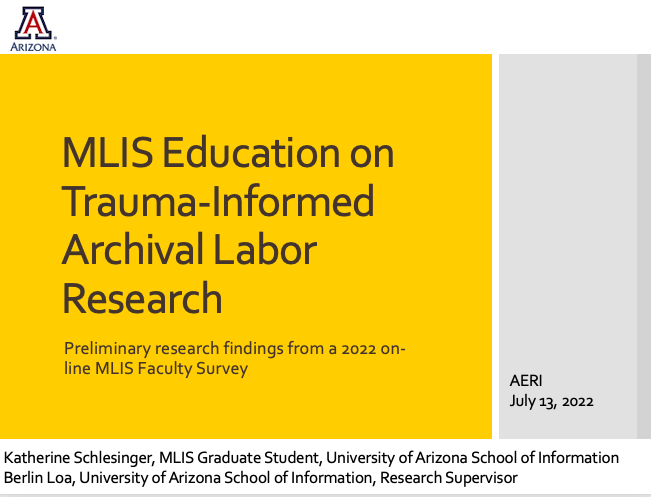
MLIS Education and Trauma-Informed Archival Labor Research

July 2022 

Archival Education and Research Initiative 


Pleased to present the preliminary results of my LIS research on MLIS Education and Trauma-Informed Archival Labor at the 2022 Critical Librarianship and Pedagogy Symposium


Kudos! Society of American Archivists Donald Peterson Travel Award

I received the Society of American Archivists 2022 Donald Peterson Travel Award. The award, a merit-based honor granted to a single graduate student, allowed me to travel to Boston for the SAA General Annual Meeting to present on the panel "Counting and Coding: Research for Archival Practice." 


Wednesday, March 31, 2021


"Unintended Consequences: Trauma-Related Archival Labor in Sensitive Collections "


Panel Presentation at So Cal Archivists Annual General Meeting 

April 27, 2021 

10:25- 11:55 AM (PDT)

Panelists: Katherine Schlesinger (MLIS student, University of Arizona, Tucson), Isaac Fellman (GLBT Historical Society, San Francisco), Joseph Quintana (United American Indian Involvement), Katie Sloan (Government of British Columbia), Genevieve Weber (Royal British Columbia Museum)

In the course of a century, theoretical thinking about the role of the archivist evolved from that of passive objective guardian of records to activist agent in the service of social justice and human rights. The shift towards activism inherently requires archivists to increase their level of exposure and engagement with sensitive collections which contain what is called aversive materials including records of state-sponsored terrorism, forced family separations, or other abuses of power. The pivot towards archival activism dovetails with the growing acceptance of the archive as a site of emotion and affect. Indeed the very nature of contemporary archival practices elicits an unavoidable emotional response from the practitioner working in sensitive collections, putting archivists at risk of trauma or stressor-related disorders. Such serious mental health outcomes could be the unintended consequence of embracing important archival activism, yet to date, the American archival community has been slow to address this risk. The proposed panel session elucidates the potential risks of trauma and stress-related illness to archival workers when working with adverse archival materials.

Trigger Warning: This panel will discuss topics related to sensitive archival materials and instances of trauma in the archives that are potentially disturbing or distressing. By putting on this program, we hope to provide a safe, open, and compassionate discussion of trauma-related archival labor. This session will not be recorded, and we ask that attendees don't record or photograph the panelists or attendees. A list of resources will be provided at the end of the discussion for those who would like to seek additional support.
Monday, January 13, 2020


New Archival Internship:  The Skirball Cultural Center Archives, Moshe Safdie Building and Design Collection

The Skirball Cultural Center by Sadfie Architects


"Responding to the steep topography at the base of the Santa Monica Mountains, the Skirball Cultural Center is organized as a series of building clusters nestled into a planted hillside. Indoor and outdoor spaces flow seamlessly throughout the complex, creating a network of gardens, courtyards, galleries and public event spaces. The center holds a museum dedicated to Jewish heritage and American democracy." (Safdie Architects)

Returning to my roots!  My father is an architect whose idea of a swell family vacation was to go to Montreal to see Moshe Safdie's 1967 landmark project, Habitat 67, a "pioneering vision of urban housing using the technology of pre-fabricated construction." At least we didn't have to move there...


Taking Note:  Creating an inventory for a private art collection

I'm fortunate to be working with an important and beautiful private collection of mid-century African-American and Latin-American art.  Comprising over 1,000 items either  framed and hanging on the walls, or lovingly stored in flat files, the collection represents the owner's lifelong interest in and advocacy for the vision of these formerly underrepresented artists.  

The job requires that I photograph, measure and research each work of art, a task that allows me to immerse myself in the imagery and history of the pieces, including the cultural context in which they were created, exhibited and collected.  Works by these artists are just now beginning to fetch record breaking prices at auction after being ignored or undervalued by mainstream museums and collectors for decades.  

Charles White, I Have a Dream, 1976. Private Collection.

Saturday, May 11, 2019


Graduate paper selected for presentation at the  Society of American Archivist Annual Conference, ARCHIVES * RECORDS 2019.

It's an honor to have my paper selected. I will be presenting it in Austin, Texas this August.

Katherine Schlesinger: The Emotional Toil and Toll of Archival Work in Sensitive Collections

"This session features the diverse research interests of three exceptional emerging professionals whose papers were chosen from a competitive pool of student submissions."

https://archives2019.sched.com/event/NjPy

Saturday, January 10, 2015

Rediscovering Paul Fusco

California Grape Strike. Ceasar Chavez. 1966.Copyright Paul Fusco/Magnum Photos
I was fortunate to be asked to contribute to the Magnum Foundation's new book titled Paul Fusco: Political America ( still in production at this time.)  A visual compendium of the major social and political movements since the 1960's, the book brought me back to historic moments in my life that were forgotten in the ever- increasing wash of images of new movements and events, as well as memories of being a young researcher in the Magnum Archives circa 1985.  I don't particularly recall many of Paul's images in those amazingly rich files: he was based in California and his work seemed under the radar.  Yet Fusco's book flows with page after page of quietly powerful photographs documenting the arc of American's struggle to defend their basic civil rights and dignity: the Berkeley Free Speech Movement, Cesar Chavez, AIDS,  homelessness, welfare, RFK's funeral train, several police brutality demonstrations, and a devastating extended story on the funerals of US soldiers killed in the Iraq Wars.   Indeed it seems as if Fusco was out there, quietly yet fiercely visually advocating where ever Americans were suffering, mistreated or defending their civil rights during my own adult life. I look forward to completing the project. Meanwhile check out Paul Fusco's work on Magnum's web site. Reintroduce yourself to an understated master.