Sunday, January 8, 2023


Trauma-Informed Archives: Preparing the Next Generation of People-Centred Archivists

6 Dec 2022 10:00 AM

By Katherine Schlesinger

As guest editors of the special issue of Archivaria on person-centred archival theory and praxis, we, Jennifer Douglas, Jessica Lapp and Mya Ballin, are pleased to share a series of blog posts that reflect on the nature and enactment of person-centred approaches to archival materials and work. These blog posts complement the articles in the special issue, presenting a variety of perspectives on how centring the person in archival processes happens and why it matters. We're grateful to the authors for sharing their research and experiences! 

It is fitting that on the 100-year anniversary of the birth of Howard Zinn, the “People’s Historian,” archivists are purposively centring people in their own work, most notably in the service of formerly marginalized and silenced communities. Zinn was a fierce advocate for the oppressed, and an opponent of the notion of “neutrality” in the archives. In a paper presented to the Society of American Archivists in 1970, Zinn characterized the archival profession as an “inevitably political craft” whose biases privileged the records and stories of powerful people and institutions over those of ordinary people and equated archival claims of neutrality with passive complicity (Zinn, 1977).  One can draw a line from Zinn’s work to current people-centred, social justice-focused archival projects addressing reconciliation, repatriation, reparations, redescription, and gaps about the lives of those previously misrepresented or excluded from the archives. Moreover, Zinn’s rejection of the notion of archival neutrality opened the door to the recognition of affect and emotion in the archive, which are vital aspects of people-centred archival praxis, in all their wonderful and terrible manifestations 

While most Library Information Science (LIS) students read and discuss the views of Howard Zinn, fewer are advised of the potential connection between social justice archival work and the emotional risks inherent in such endeavors for archivists and users of the archive, including the risk of trauma. This begs the question, is archival education sufficiently preparing the newest generation of archival professionals?  

Trauma is medically defined as “an emotional reaction to incidents of death, physical or sexual violence,” or to “extreme or repeated exposure to aversive details of traumatic events which only applies to workers who encounter the consequences of traumatic events as part of their professional responsibilities,” (Pai, North & Suris, 2017, p.3). It is the latter part of this description, a phenomenon also termed secondary or vicarious trauma, that puts archivists at risk while either working directly with aversive materials, or interacting with the people described in the records, or their survivors.  

Archives are full of traumatic materials, records describing the ordeals suffered by individuals, families, or communities, at times the direct relatives or ancestors of the very patrons wanting to access these records. What is considered aversive materials is subjective in the context of both cultural and personal terms.  However, they are most often associated with collections of documents about police violence, state-sponsored terrorism, or systematic societal abuses of power, such as slavery and forced family separations.  As communities begin to demand accountability for such actions, archivists are called upon to engage with these archival documents as evidence of past wrongdoings, for the purposes of reconciliation, reparations, or healing.  Repeated engagement with materials that document trauma can elicit a powerful emotional response from the archivist and the user, leading to serious mental stress disorders, including trauma.  

In the past, the archival profession suppressed the notion of emotional response, a shadow that still lingers over the profession and is compounded by society’s stigma surrounding mental health disorders or needs. However, archivists can embrace their humanity and acknowledge their emotional response to archival material while balancing the important work of people-centred, social-justice-focused archiving.   

To their credit, archivists and archival educators have recently initiated open and supportive discussions about archival trauma and recognize the need to create supportive environments and mindsets to care for those impacted by archival trauma. The profession is in the early stages of developing training and resources, mostly geared towards working professionals. Pilot programs for trauma-informed archival management have met success most notably in Canada, New Zealand, and Australia.   

However, is the archival community overlooking the necessity and the opportunity to educate its newest members? Knowledge about the risk of trauma in the archive and training in trauma-informed archival management should ideally be provided at the LIS graduate student level, to prepare the next generation of people-centered archivists before they encounter traumatic materials in their first internship or job. As new archival literature is published on archival trauma and management, and workshops are more readily available online, it’s time to begin to extend this knowledge and training to LIS students. Newly minted archivists are eager to take up the call for social justice archival work. Trauma-informed training can only enhance their ability to approach such projects in a safe, effective, and truly people-centred manner. 


References

Pai, A., North, C. & Suris, A. (2017). Posttraumatic Stress Disorder in the DSM-5: Controversy, Change, and Conceptual Considerations [Review of the book Diagnostic and Statistical Manual of Mental Disorders, 5th ed.; American Psychiatric Association: Arlington, VA, USA, 2013]. Behavioral Sciences 7(1); doi:10.3390/bs7010007. Retrieved from https://www.mdpi.com/2076-328X/7/1/7/htm 

Zinn, H. (1977). Secrecy, Archives, and the Public Interest. The Midwestern Archivist, 2(2), 14-26. Retrieved from http://www.jstor.org/stable/41101382. 

*****************

Katherine Schlesinger is a Master of Library Science candidate at the University of Arizona, Tucson. Her academic interest is in emotion and affect in the archive. She is a member of Trauma-Informed Archives: A Community of Practice. 

https://archivists.ca/Blog/13015427

Friday, October 28, 2022


Presentation 

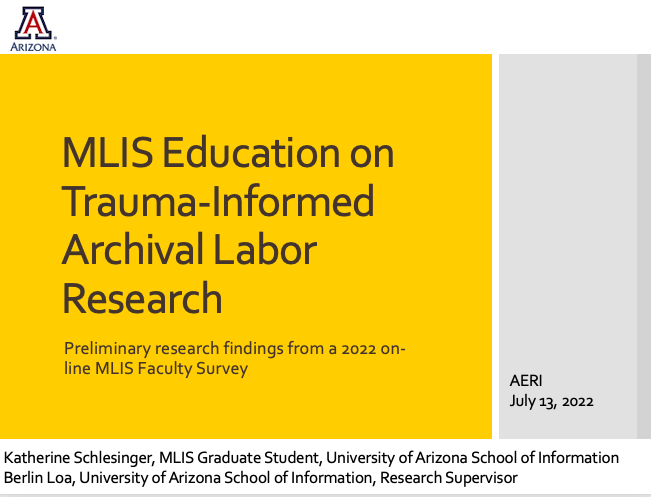
MLIS Education and Trauma-Informed Archival Labor Research

July 2022 

Archival Education and Research Initiative 


Pleased to present the preliminary results of my LIS research on MLIS Education and Trauma-Informed Archival Labor at the 2022 Critical Librarianship and Pedagogy Symposium


Kudos! Society of American Archivists Donald Peterson Travel Award

I received the Society of American Archivists 2022 Donald Peterson Travel Award. The award, a merit-based honor granted to a single graduate student, allowed me to travel to Boston for the SAA General Annual Meeting to present on the panel "Counting and Coding: Research for Archival Practice." 


Wednesday, March 31, 2021


"Unintended Consequences: Trauma-Related Archival Labor in Sensitive Collections "


Panel Presentation at So Cal Archivists Annual General Meeting 

April 27, 2021 

10:25- 11:55 AM (PDT)

Panelists: Katherine Schlesinger (MLIS student, University of Arizona, Tucson), Isaac Fellman (GLBT Historical Society, San Francisco), Joseph Quintana (United American Indian Involvement), Katie Sloan (Government of British Columbia), Genevieve Weber (Royal British Columbia Museum)

In the course of a century, theoretical thinking about the role of the archivist evolved from that of passive objective guardian of records to activist agent in the service of social justice and human rights. The shift towards activism inherently requires archivists to increase their level of exposure and engagement with sensitive collections which contain what is called aversive materials including records of state-sponsored terrorism, forced family separations, or other abuses of power. The pivot towards archival activism dovetails with the growing acceptance of the archive as a site of emotion and affect. Indeed the very nature of contemporary archival practices elicits an unavoidable emotional response from the practitioner working in sensitive collections, putting archivists at risk of trauma or stressor-related disorders. Such serious mental health outcomes could be the unintended consequence of embracing important archival activism, yet to date, the American archival community has been slow to address this risk. The proposed panel session elucidates the potential risks of trauma and stress-related illness to archival workers when working with adverse archival materials.

Trigger Warning: This panel will discuss topics related to sensitive archival materials and instances of trauma in the archives that are potentially disturbing or distressing. By putting on this program, we hope to provide a safe, open, and compassionate discussion of trauma-related archival labor. This session will not be recorded, and we ask that attendees don't record or photograph the panelists or attendees. A list of resources will be provided at the end of the discussion for those who would like to seek additional support.

Monday, January 13, 2020


New Archival Internship:  The Skirball Cultural Center Archives, Moshe Safdie Building and Design Collection

The Skirball Cultural Center by Sadfie Architects


"Responding to the steep topography at the base of the Santa Monica Mountains, the Skirball Cultural Center is organized as a series of building clusters nestled into a planted hillside. Indoor and outdoor spaces flow seamlessly throughout the complex, creating a network of gardens, courtyards, galleries and public event spaces. The center holds a museum dedicated to Jewish heritage and American democracy." (Safdie Architects)

Returning to my roots!  My father is an architect whose idea of a swell family vacation was to go to Montreal to see Moshe Safdie's 1967 landmark project, Habitat 67, a "pioneering vision of urban housing using the technology of pre-fabricated construction." At least we didn't have to move there...


Taking Note:  Creating an inventory for a private art collection

I'm fortunate to be working with an important and beautiful private collection of mid-century African-American and Latin-American art.  Comprising over 1,000 items either  framed and hanging on the walls, or lovingly stored in flat files, the collection represents the owner's lifelong interest in and advocacy for the vision of these formerly underrepresented artists.  

The job requires that I photograph, measure and research each work of art, a task that allows me to immerse myself in the imagery and history of the pieces, including the cultural context in which they were created, exhibited and collected.  Works by these artists are just now beginning to fetch record breaking prices at auction after being ignored or undervalued by mainstream museums and collectors for decades.  

Charles White, I Have a Dream, 1976. Private Collection.

Saturday, May 11, 2019


Graduate paper selected for presentation at the  Society of American Archivist Annual Conference, ARCHIVES * RECORDS 2019.

It's an honor to have my paper selected. I will be presenting it in Austin, Texas this August.

Katherine Schlesinger: The Emotional Toil and Toll of Archival Work in Sensitive Collections

"This session features the diverse research interests of three exceptional emerging professionals whose papers were chosen from a competitive pool of student submissions."

https://archives2019.sched.com/event/NjPy

Saturday, January 10, 2015

Rediscovering Paul Fusco

California Grape Strike. Ceasar Chavez. 1966.Copyright Paul Fusco/Magnum Photos
I was fortunate to be asked to contribute to the Magnum Foundation's new book titled Paul Fusco: Political America ( still in production at this time.)  A visual compendium of the major social and political movements since the 1960's, the book brought me back to historic moments in my life that were forgotten in the ever- increasing wash of images of new movements and events, as well as memories of being a young researcher in the Magnum Archives circa 1985.  I don't particularly recall many of Paul's images in those amazingly rich files: he was based in California and his work seemed under the radar.  Yet Fusco's book flows with page after page of quietly powerful photographs documenting the arc of American's struggle to defend their basic civil rights and dignity: the Berkeley Free Speech Movement, Cesar Chavez, AIDS,  homelessness, welfare, RFK's funeral train, several police brutality demonstrations, and a devastating extended story on the funerals of US soldiers killed in the Iraq Wars.   Indeed it seems as if Fusco was out there, quietly yet fiercely visually advocating where ever Americans were suffering, mistreated or defending their civil rights during my own adult life. I look forward to completing the project. Meanwhile check out Paul Fusco's work on Magnum's web site. Reintroduce yourself to an understated master.

Wednesday, May 26, 2010

Initial Collection Archive

Build an image specific database containing a digital visual and written record of each asset.

Create a physical archive using archival materials and procedures to protect and organize assets.

Provide client with a complete digital and hard copy catalog of the archive.

On-Going Collection Editing and Management

Update archives with new acquisitions.

Editing of archival assets for project use. Research on historic context of assets.

Coordinate insurance appraisals and maintain financial files for all assets.

Supervise conservation, storage, framing, and shipping.

Organize and supervise collection–based projects including books, exhibitions, and loans.


About Kate Schlesinger

Kate Schlesinger is an archivist, photography editor, researcher, and writer. 

Kate is dedicated to the sustainable management, preservation, and access of photographs, objects, and documents. She will complete her Master's in Library Sciences and Information with a focus on Archival Studies from the University of Arizona in December 2022. In 2020 she earned a Graduate Certificate in Archival Studies from the university. Kate completed hands-on internships at the Skirball Cultural Center and the Autry Museum Libray and Archives, both in Los Angeles. Additionally, Kate presented her work on trauma-informed archival labor at the Society of American Archives and the California Society of Archivists.

Kate most recently cataloged an important private collection of mid-century African-American and Hispanic art using Catalogit. She served as archivist for a privately held photo collection belonging to the family of a late Hollywood magnate. Since 2010, Katherine has scanned and archived approximately 20,000 assets including photographs and documents, and created a sustainable and accessible physical and digital archive of the materials for use in exhibitions and books.

Kate has a deep knowledge of the history of photography. She began her photo career as a photo researcher at Magnum Archives, New York, the active repository of the works of many of the greatest 20th-century photojournalists including Henri Cartier- Bresson, Robert Capa, Susan Mieselas, Danny Lyon, and Bruce Davidson. At that time she studied the art and science of photographic archiving at the International Center for Photography, where she began a network of other like-minded photography archivists, researchers, editors, and curators, all passionate about photographs and all with the highest visual and working standards. Kate edited her first photography book, Guatemala:, Eternal Spring, Eternal Tyranny by photojournalist Jean Marie Simon.

Based on her visual acuity and archival experience Kate was selected to work with Weston Naef, then Curator of Photography at the Metropolitan Museum of Art, to serve as the Coordinator of Photographic Research for a series of twelve books on the history of photography. Kate organized a physical archive of over 100,000 copy prints culled by a team of researchers from the most prestigious museums, private collections, and archives worldwide. Kate herself undertook the research at many key 19th and 20th century collections including the archives at the Gernsheim Collection at the University of Texas, Austin, The Center for Creative Photography at the University of Arizona, and numerous private collections and galleries in New York City.

Kate’s next position was photography researcher at Vanity Fair magazine, where she used her archival savvy and photographic keenness to find delightful images of the famous and infamous, past and present She was nicknamed ”Dick Tracey” due to her tenacious ability to find and obtain rights for often previously unseen, stunning images. Her work was brought to the attention of Anna Wintour, Editor in Chief of Vogue Magazine, who hired Kate to work with her on a series of special photography projects. Soon after, Kate was appointed Vogue’s first Features Photography Editor, and was privileged to work on a daily basis with the legendary Creative Director, Alexander Liberman. Kate spent 6 years organizing and producing photography sessions with the world’s top photographers and searching out fresh, new talents. Together they created images to accompany the magazine’s feature stories on world-famous persons, arts, news, food, and style. While at Vogue, Kate studied art history with Robert Rosenblum and Kurt Varnedoe, and curated an exhibition at NYU Art Gallery, Photographers Who Make Films.
Kate forwarded her career by obtaining an MBA from UCLA in Non- Profit and Arts Management. During her graduate school years, she was contracted to work as the photo editor of Dance Ink Magazine, a privately funded fine art magazine dedicated to writing, photography and visual art related to the world's finest dancers and choreographers. Katherine commissioned dozens of stunning photographs for the publication, which was nominated for the National Magazine Award in Photographic Excellence.

Kate transitioned her visual organizational skills into advertising and marketing, working for over 10 years working with top art directors from Saatchi & Saatchi on international fine wine and spirit accounts. She lived for ten years in New Zealand where she continued to produce photography shoots for Dance Ink and Twice magazine, introducing photographers from that region. Upon returning to the USA, she was a member of an international digital team effort to produce the prototype for New Zealand Magazine.

Most recently Kate is a contributing writer for the Magnum Foundation's upcoming publication, Paul Fusco: Political America.  Kate undertook in-depth research on the events and times depicted and wrote the contextual historical texts for the book. 


Photographs copyright top to bottom:  Still from Man Ray's L'Etoile de Mer from "Photographers Who Make Films" exhibition, Duane Michaels, Jean Marie Simon, Andrew Eccles.